Pre-Deployment
Calibration
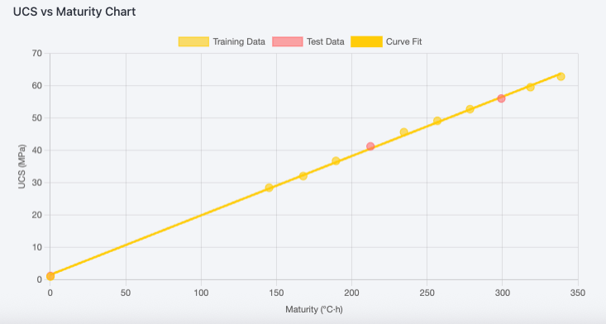
Each barricade shotcrete mix design requires a site-specific calibration curve established through beam end testing in accordance with ASTM C1074. Changes to accelerator dosage, cement type, or constituent materials require re-calibration. The validated curve is loaded into the platform and assigned to the relevant barricades.

Operational Workflow
The sensor matrix installation takes minutes and requires no specialist skills. The operator attaches the three sensor lines to the barricade mesh, activates the transmitter, and shotcrete application proceeds as normal. From that point, monitoring is fully automated.
Daily Operations
Operator Tasks (Per Stope)
- Install sensor matrix on the barricade reinforcement mesh before shotcrete application for each barricade.
- Activate the wireless transmitter and confirm the gateway has registered the device.
- Verify sensor registration on the dashboard after shotcrete application. The gateway auto-detects new sensor matrices; the operator confirms barricade assignment.
Engineering Monitoring
- Monitor the real-time dashboard for barricade status: Sprayed, Curing, or Design Strength Achieved.
- Review strength development curves and spatial distribution across the barricade face.
- Investigate thermal gradients or anomalies that may indicate cold spots, insufficient thickness, or sensor issues.
Pour Approval
When the system indicates a barricade has reached design strength across all sensor positions, engineering authorises pour commencement. For critical or high-risk barricades, the geotechnical engineer can place a manual hold — preventing automated clearance regardless of sensor data. All overrides and manual approvals are recorded in the audit trail.
Integration with Mine Systems
Data Flow
The Safewall system connects to mine dispatch and paste plant platforms via the REST API. The integration supports:
- Automated pour scheduling: Clearance signals transmitted directly to dispatch and paste plant operations enable pour scheduling without manual communication.
- Status board updates: Barricade status (Sprayed, Curing, Design Strength Achieved) displayed on mine-wide status boards and control room displays.
- Shift handover reports: Curing status and expected clearance times for all active barricades included in automated handover reports.
Audit Trail
Every clearance event is timestamped and archived with the full sensor dataset — temperature readings, maturity calculations, and strength estimates. This provides a complete compliance record for geotechnical review and regulatory reporting. Historical data supports analysis of barricade performance trends, curing time distributions, and mix design optimisation.